
Graymail: The Email Between Wanted and Spam
Learn what graymail is, how it differs from spam, how Microsoft BCL filtering works, and how better targeting and list hygiene protect email deliverability.
Graymail is one of the most misunderstood categories in email. It is not the same as malicious spam, yet unwanted bulk messages can still hurt inbox placement, engagement, and sender reputation.
This guide explains what graymail is, why inbox providers care about it, how it affects deliverability, and what senders should do about it. It is for marketers, sales teams, IT administrators, and anyone responsible for email deliverability.
What is graymail?
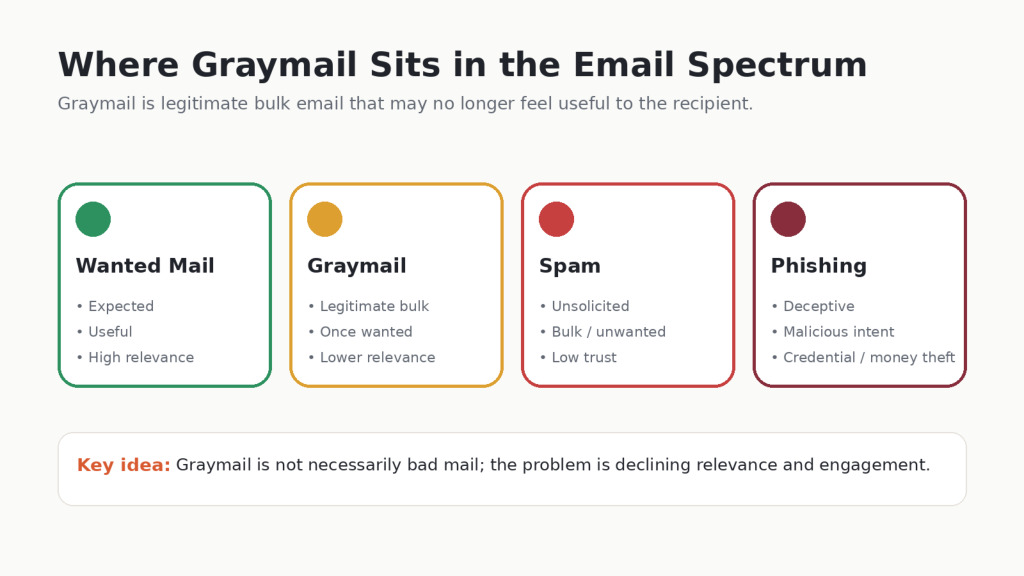
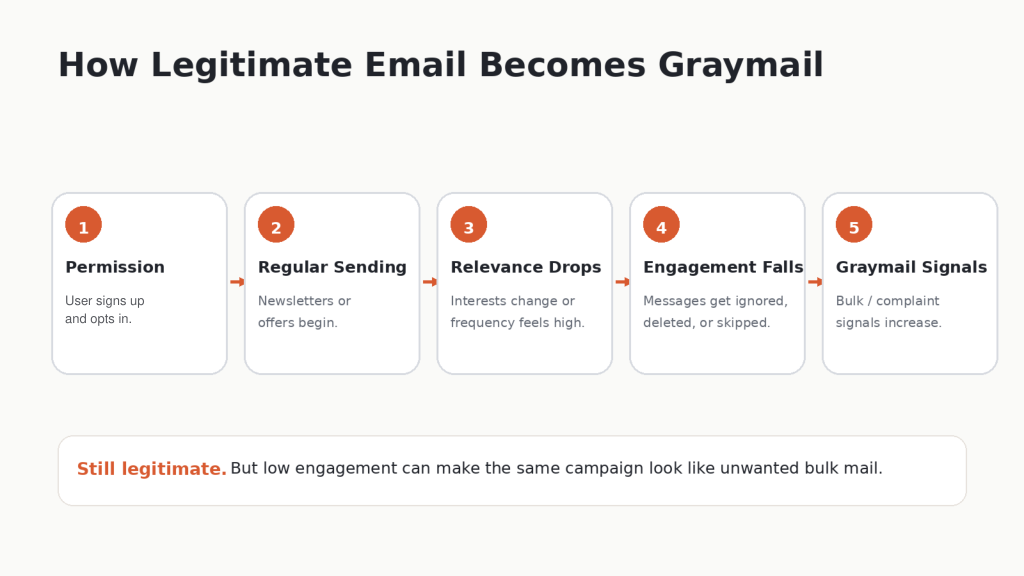
Graymail is legitimate bulk email whose desirability depends on the recipient. It often sits in the middle ground between clearly wanted email and obvious spam. The recipient may have signed up for a newsletter, opted into updates, or provided an email address during a purchase, resource download, or event. The sender may be legitimate and properly authenticated. The problem is relevance: the recipient no longer finds the messages useful, or receives them more often than they want.
Providing an email address or making a purchase does not automatically establish permission for ongoing marketing. Senders still need to meet the applicable consent, privacy, and opt-out requirements.
Microsoft describes bulk email, also known as gray mail, as newsletters, marketing messages, and promotions that users opted in to receive. Cisco Talos describes graymail as legitimate commercial bulk email that is usually subscription-based and sometimes unwanted.
That distinction matters. Spam is generally unsolicited and unwanted. Phishing is deceptive and malicious. Graymail may be lawful, authenticated, and permission-based, but still lead to complaints or filtering when recipients no longer want it.
Common examples of graymail
Typical graymail includes newsletters that a user stopped reading, retail promotions after a one-time purchase, webinar or conference follow-ups, SaaS product announcements, event invitations, recurring offers, social-network notifications, content digests, and promotional messages from services the recipient once used.
A message does not become graymail simply because it is marketing. A highly relevant newsletter that a recipient regularly reads and interacts with is wanted mail. The same newsletter sent to an inactive subscriber for two years may effectively behave like unwanted graymail.
Graymail vs. spam vs. phishing
The easiest way to understand graymail is to think in terms of permission, intent, and current relevance:
- Wanted mail is expected and useful.
- Graymail is usually legitimate and often permission-based, but its relevance may have faded.
- Spam is unsolicited or broadly unwanted bulk messaging.
- Phishing uses deception to steal credentials, money, or sensitive information.
These are useful distinctions, not mutually exclusive technical labels used identically by every provider. One recipient may value a message while another considers the exact same campaign annoying.
How inbox providers recognize graymail
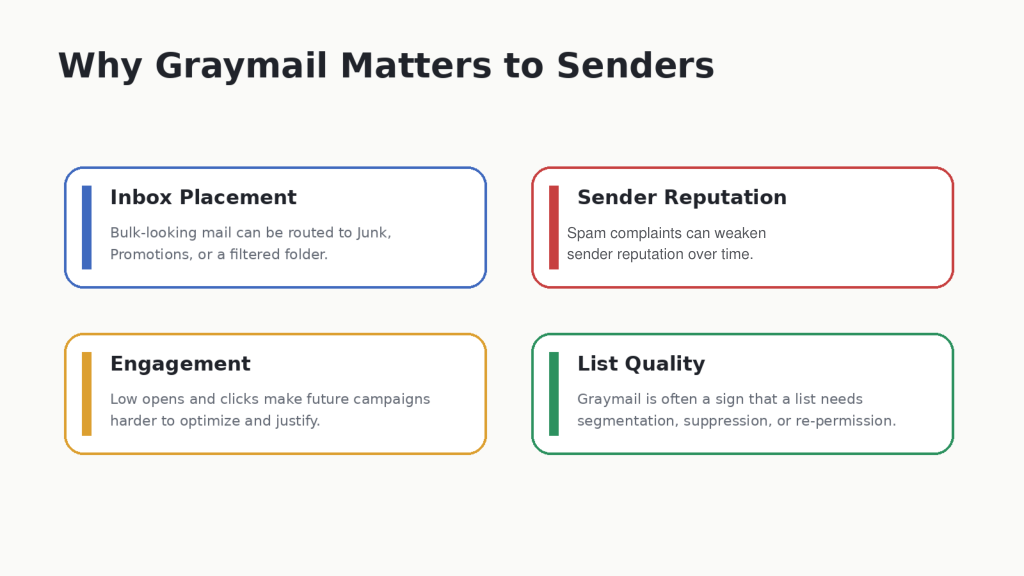
Modern email filtering is not based on a single rule. Providers evaluate multiple signals, including sending patterns, message content, recipient feedback, historical complaint levels, bulk characteristics, authentication, and reputation. Each provider weighs signals differently.
In Microsoft 365, inbound messages are assigned a Bulk Complaint Level (BCL) from 0 to 9. A value of 0 indicates that the message is not from a bulk sender; higher values indicate bulk senders associated with greater complaint levels.
Administrators can configure a BCL threshold in anti-spam policies. Messages at or above the threshold are treated as bulk and receive the configured action, such as delivery to Junk or quarantine. Administrators should inspect the applicable policy rather than assume every organization uses the same threshold.
This does not mean BCL is a universal “graymail score” across all providers. It is a Microsoft-specific mechanism. Gmail, Yahoo, Cisco, and other providers use their own systems and signals.
Why graymail hurts deliverability
Graymail can create a negative feedback loop. Recipients lose interest; some stop interacting, unsubscribe, or mark messages as spam. Spam complaints can reduce the likelihood that future messages reach the inbox and damage sender reputation.
There is an important measurement caveat: low tracked open rates do not, by themselves, prove that providers are penalizing a sender. Google explicitly says it does not track open rates, cannot verify third-party open-rate measurements, and does not consider low open rates a reliable indicator of deliverability or spam classification problems. Provider filtering signals should not be confused with the tracking metrics in a sending platform.
For a sender, the danger is that a campaign can remain technically “successful”—mail is accepted and not hard-bounced—while its practical performance deteriorates. Deliverability is not merely whether a server accepted the message. Destination folders and useful recipient responses matter too. A Promotions folder is also not the same as spam; subscribed marketing can legitimately belong there.
For more on diagnosing inbox-placement problems, see why cold emails go to spam.
The business cost of graymail
The impact is broader than inbox placement. Graymail inflates database size while depressing engagement metrics. It wastes sending capacity, makes A/B tests less reliable, increases complaint risk, and can obscure which audiences genuinely want the content.
For cold outreach and high-volume outbound teams, the lesson is especially important: infrastructure quality cannot compensate indefinitely for poor targeting or stale data. Authentication, healthy sending domains and mailboxes, and controlled sending volumes matter, but relevance remains essential.
Cold outreach is not automatically graymail. Unlike the classic opted-in newsletter example, unsolicited prospecting may be treated as spam and is subject to provider policies and applicable laws. Calling it graymail does not establish consent or make it acceptable. Our cold email compliance guide explains the distinctions senders need to consider.
How senders can reduce graymail
The goal is not to eliminate marketing email. The goal is to send less unwanted email and more relevant email.
-
Segment aggressively. Avoid sending every message to every contact. Segment by lifecycle stage, interest, industry, geography, purchase behavior, activity, or product usage.
-
Suppress long-term non-engagers. A large list is not automatically a valuable list. Subscribers who have ignored many consecutive campaigns should enter a re-engagement or suppression workflow. Use meaningful activity, such as replies, conversions, and product usage, alongside email metrics rather than deciding from tracked opens alone.
-
Make unsubscribe simple. Legitimate bulk email should provide a working unsubscribe path. Friction makes recipients more likely to use the spam button instead. Where provider rules require it, implement one-click unsubscribe as well as a visible opt-out link; Google's bulk-sender requirements spell out the conditions for personal Gmail recipients.
-
Control frequency. Even wanted content can become unwanted when it arrives too often. Use preference centers where possible so recipients can choose topics and frequency.
-
Separate message types. Keep transactional email, product notifications, marketing, and outbound prospecting operationally distinct where practical. This makes troubleshooting easier, but separate streams do not guarantee isolation from shared domain or IP reputation.
-
Monitor complaints and engagement. Watch spam complaints, unsubscribe rates, bounce patterns, replies, clicks, conversions, and mailbox-provider feedback where available. Treat tracked opens as a limited diagnostic signal rather than proof of inbox placement. A sudden change is often more useful than a single isolated metric.
-
Review older audiences and permissions. If consent is old, review whether you still have a valid basis to contact the recipient. Where permitted, ask whether they still want the content. Suppress non-responders rather than mailing indefinitely. If you cannot establish a lawful basis for contact, suppress the address rather than sending a “permission” campaign to it.
-
Authenticate correctly. SPF, DKIM, and DMARC do not make unwanted email wanted, but correct authentication helps providers verify sender identity and is a foundational deliverability practice. See our SPF, DKIM, and DMARC guide for the technical setup.
What recipients can do with graymail
Recipients should avoid reporting every legitimate newsletter as phishing. If the message is from a trusted sender but is no longer wanted, use the unsubscribe option where appropriate, adjust notification preferences, create inbox rules, or move recurring promotional mail to a separate folder.
For clearly deceptive messages, suspicious login requests, malware, fake invoices, credential theft attempts, or impersonation, use phishing/reporting controls instead. Do not click an unsubscribe link in a suspicious message; use your email provider's reporting controls or visit the known service directly.
A practical graymail checklist
Ask these questions before launching a bulk campaign:
- Did the recipient reasonably expect this message?
- Do we have an appropriate basis to contact this audience?
- Is the content relevant to the segment receiving it?
- Are we emailing inactive contacts simply because we still have their address?
- Is the sending frequency justified?
- Is unsubscribe easy and functional?
- Are SPF, DKIM, and DMARC configured correctly?
- Are complaints, bounces, and meaningful engagement monitored?
- Do we suppress persistently inactive recipients?
- Are transactional and promotional streams separated where possible?
- Would we still send this message if we were paying for every single send individually?
If several answers are weak, the campaign is at risk of becoming unwanted bulk mail—regardless of how polished the email looks.
Final takeaway
Graymail is the category that demonstrates deliverability is not purely technical. You can have valid DNS records, authenticated mail, clean IPs, and a professional template and still lose inbox placement if recipients consistently report what you send as spam.
The strongest long-term strategy combines sound infrastructure, careful targeting, controlled volume, good list hygiene, easy opt-out, and content people actually want to receive.
Sources
Definitions and provider-specific claims were checked against these primary sources on October 7, 2026:
Written by
The Mailflo Team
The Mailflo team helps B2B sales teams land in the inbox and book more meetings through bulletproof email deliverability and smart automation.
LinkedIn